Used IBC Totes: Truckload Pricing & What Affects Cost
Used IBC tote prices run roughly $95–$185 for 275-gallon units and $170–$250 for 330-gallon reconditioned units at small-quantity list pricing, with rebottled units (new bottle on a used cage) costing more. At truckload scale, the meaningful number is the all-in delivered price per tote — driven by grade, prior contents, and freight, with roughly 60 totes per full 53-foot trailer. Here’s how wholesale buyers should read those numbers.
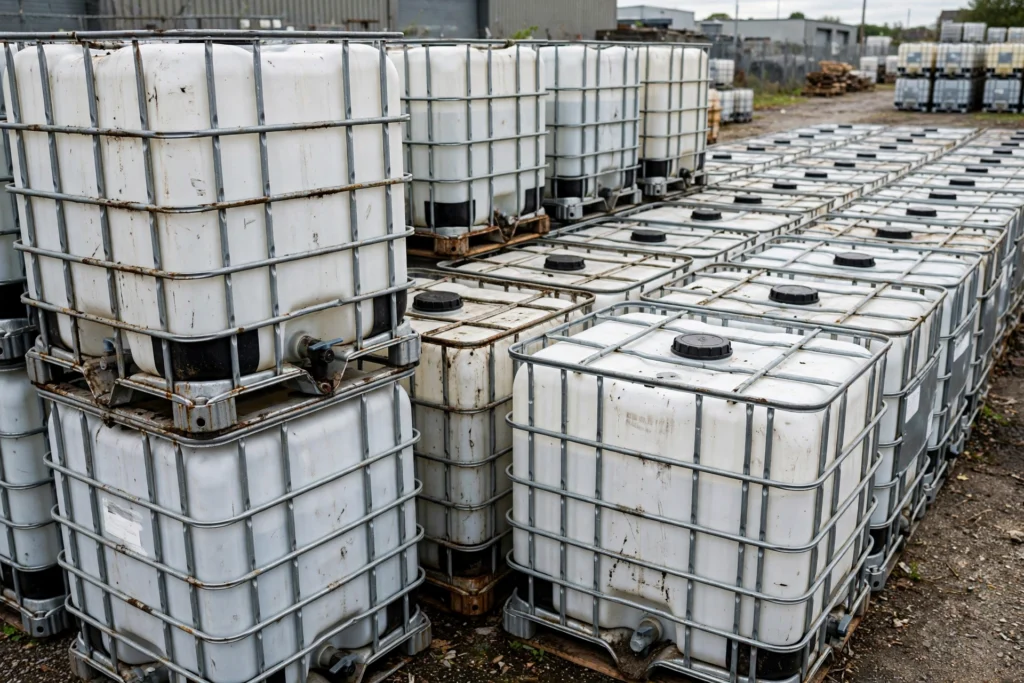
Used, reconditioned, or rebottled: know what you’re pricing
Three distinct products all get called “used IBC totes,” and the price spread between them is wide:
- Used / as-is — sold as they came in, rinsed at best. Cheapest, but prior contents are often unverified.
- Reconditioned — triple-washed, pressure-tested, inspected, with documented prior contents; the UN plate typically stays with the unit. The workhorse grade for industrial buyers.
- Rebottled — a brand-new HDPE inner bottle mounted on a reconditioned cage and pallet. The closest thing to a new tote at a meaningful discount, and the right pick when the inner container’s history must be pristine.
Most of the list prices you see online are reconditioned units at small quantities — 1 to 30 totes. Quote-stage buyers should treat them as reference points, not targets.
What used IBC totes cost at small-quantity list pricing
| Grade | 275-gallon typical list range | 330-gallon typical list range | Best for |
|---|---|---|---|
| Used / as-is | $95–$175 | $120–$190 | Non-potable water storage, rainwater, construction site use |
| Reconditioned | $155–$185 | $170–$250 | Industrial liquids, detergents, non-food chemicals |
| Rebottled (new bottle) | $250–$295 | $287–$380 | Applications needing a clean, documented inner bottle |
Two things to know before you use these numbers: first, they’re single-unit or small-quantity list prices — freight is almost never included. Second, truckload buyers don’t pay list. A full truckload is priced as one all-in delivered number, and the per-tote result lands below every figure above.
Truckload math: why quantity changes the price
A standard 53-foot trailer carries roughly 60 standard IBC totes (48″ × 40″ footprint, stacked two high). Freight is billed per truck, not per tote — so the buyer taking a full 60-tote load spreads one freight bill across maximum units, while the buyer taking 10 pays nearly the same freight for a sixth of the totes.
That single fact explains most of the gap between list prices and truckload quotes. Half truckloads are available for buyers who can’t take a full 60, and per-tote cost improves steadily as the count climbs. Buyers comparing suppliers should always compare delivered per-tote pricing at the same quantity — FOB numbers are not comparable.
Five factors that set your delivered tote price
1. Size: 275 vs 330 gallons
330-gallon totes cost more per unit but carry ~20% more product per floor footprint (same 48″ × 40″ base, taller bottle). If your freight cost is the dominant line item, the larger tote often wins on cost per gallon shipped. Check your fill weight — a 330-gallon tote full of 1.9 specific-gravity liquid runs close to 2,750 lb plus the cage.
2. Grade and certification
A reconditioned tote with a documented 3-stage wash and pressure test costs more than an as-is tote from a classifieds ad, and it’s worth more. For anything beyond water storage, certification paperwork is part of what you’re buying — budget for it.
3. Prior contents
Totes that held food-grade or water products (syrups, flavorings, potable water) command a premium because their history is safe for more applications. Totes with chemical history need careful compatibility matching. Ask for prior-contents documentation in writing — never rely on “looks clean.”
4. Valve, fittings, and cage condition
A 2″ ball valve with a quick-disconnect outlet costs more than a basic butterfly valve; camlock adapters and new gaskets add dollars. Check the cage for bent uprights and the pallet base for damage — a tote that won’t stack safely three-high costs you warehouse space.
5. Freight lane and delivery access
Distance from the supply point, backhaul availability, and whether you have a loading dock (vs. needing a liftgate) swing the delivered number. Our bulk price guide explains how delivered pricing is built up.
Buying at truckload scale? Tell us your size, grade, quantity, and delivery location.
Get an All-In Delivered QuoteHow to buy used IBC totes without overpaying
- Get all-in delivered quotes — per-tote price before freight is a meaningless number
- Demand prior-contents paperwork — on used totes this is a QA requirement, not a courtesy
- Inspect the UN plate — it tells you the tote’s original rating (e.g., 31HA1); confirm it covers your use case
- Match tote to product — check chemical compatibility and the specific-gravity rating (most are rated to 1.9 SG)
- Check valve and gasket — replacements are cheap; discovering a bad seal mid-fill is not
- Consolidate loads — IBC totes plus drums and pails on one truckload splits freight across everything
Facilities storing or dispensing chemicals should also review OSHA’s chemical hazard guidance for workplace handling and storage requirements.
For context on the drum side of a mixed load, see our 55-gallon drum cost breakdown — the same truckload economics apply.
Used IBC tote pricing FAQs
How much do used IBC totes cost?
At small-quantity list pricing, expect roughly $95–$185 for 275-gallon units and $170–$250 for reconditioned 330-gallon units, with rebottled (new-bottle) units higher. Truckload buyers pay an all-in delivered per-tote price below list — get a delivered quote for your real number.
What’s the difference between used, reconditioned, and rebottled totes?
Used/as-is totes are sold as received with unverified history. Reconditioned totes are washed, pressure-tested, inspected, and documented. Rebottled totes have a brand-new HDPE inner bottle on a reconditioned cage — the cleanest option short of new.
How many IBC totes fit on a truckload?
A full 53-foot trailer carries roughly 60 standard IBC totes. Half truckloads are available. Freight is billed per truck, so per-tote delivered cost drops sharply as you approach a full load — quantity is the biggest lever on price.
Can I use a used IBC tote for food products or drinking water?
Only with verified one-time food-grade prior contents and documentation — totes that held only water, syrups, or flavorings. Totes with any chemical history should not be repurposed for food or potable water. When in doubt, rebottled or new is the safe specification.
What should I inspect on a used IBC tote before buying?
Check the UN plate and date, the valve and gasket condition, the lid seal, the cage for bent uprights, and the pallet base for damage. Ask for the wash/inspection report and prior-contents documentation before money changes hands.
Do used IBC totes keep their UN rating?
The UN “birth certificate” stays with the cage, and reconditioned units typically retain their original rating when properly washed and requalified — but the rating must be verified against your specific product and fill weight. Your SDS and freight carrier determine whether UN-rated packaging is required.
Can I combine IBC totes with drums and buckets in one truckload?
Yes — mixed loads are standard practice. Consolidating totes with drums and pails on a single trailer spreads one freight bill across everything, which usually beats separate shipments. Industrial and contractor buyers use this routinely.
Buying totes at scale?
Get an all-in delivered truckload quote — tell us your size, grade, quantity, and delivery location and we’ll price it dock-to-dock.